
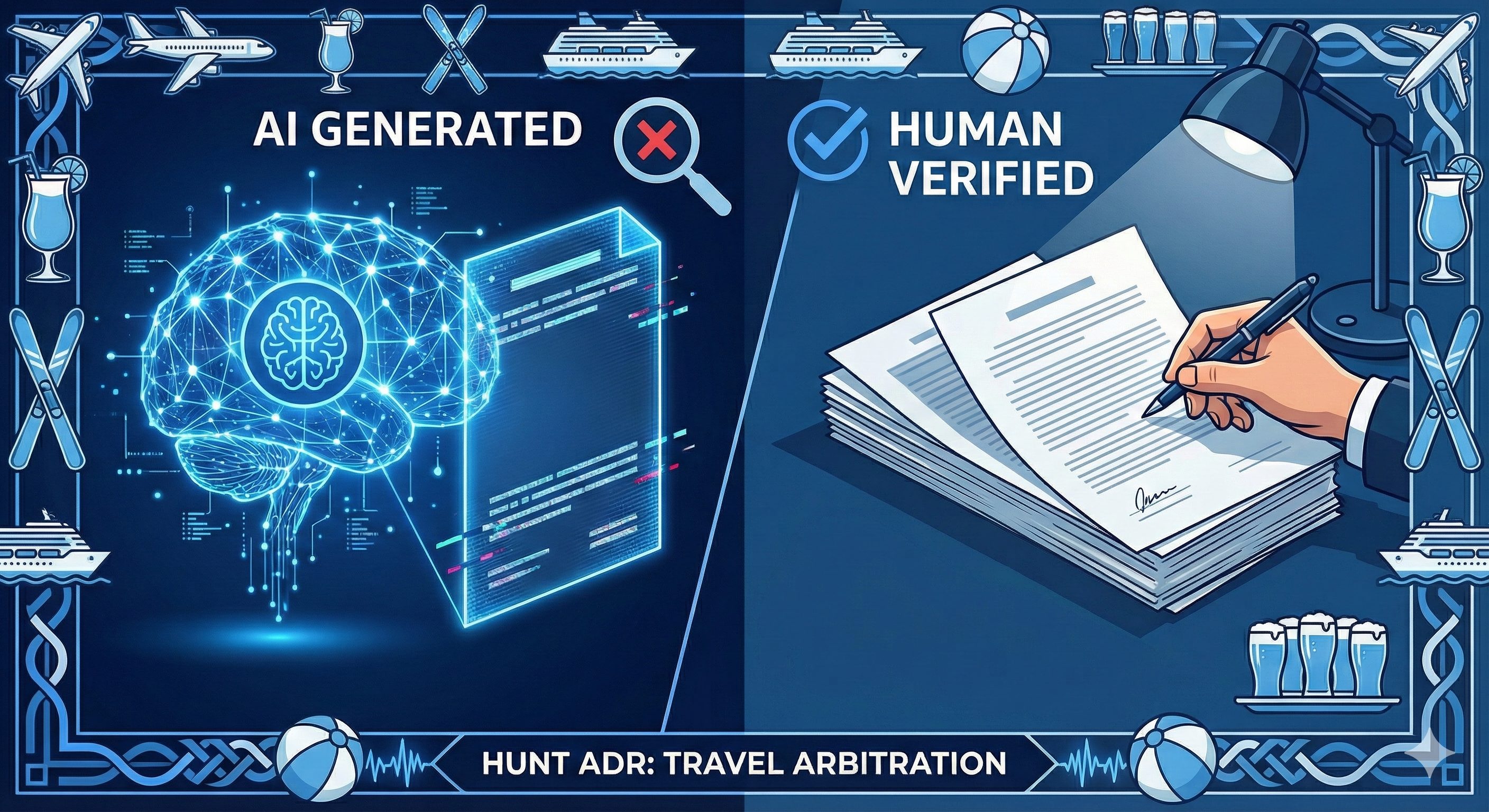
Guidance Note: The Use of AI Tools in Travel Arbitration
Why accurate, human-verified evidence is essential for resolving holiday disputes.
Artificial Intelligence tools have rapidly become part of everyday life. At Hunt ADR, we embrace innovation; we utilise AI in our own triage and training systems. However, as the independent arbitration infrastructure for the UK travel industry, we must address a concerning trend in recent case filings.
We are observing an increasing number of submissions that appear to have been prepared using unverified AI tools. While such tools can be helpful for structuring a complaint or drafting a response, they pose significant risks when used as a substitute for factual accuracy or genuine evidence regarding a holiday dispute.
This Guidance Note clarifies Hunt ADR’s position on the use of AI in our travel arbitration schemes.
1. The “Hallucination” Trap: Accuracy is Your Responsibility
Generative AI models are prediction engines, not legal databases. They do not “know” the law; they predict the next plausible word in a sentence.
In the context of package holiday disputes, we have identified submissions that:
- Cite the wrong regulations: Quoting irrelevant statutes – we have even seen submissions citing UK Housing Law to argue accommodation standards – instead of the applicable Package Travel and Linked Travel Arrangements Regulations 2018.
- Invent “facts”: Referencing “landmark” court cases regarding package holidays that simply do not exist.
- Misinterpret Terms: Confusing standard travel insurance terms with statutory rights under the Package Travel Regulations.
The Hunt ADR Standard:
Our arbitrators are subject-matter experts in travel arbitration law. Submitting an AI-generated argument that cites a non-existent regulation does not strengthen your case; it undermines your credibility. If you utilise AI to draft your claim or defence, you must verify every legal reference against current UK travel law.
2. The “Red Line”: Fabricated Evidence
More concerning is the rising availability of AI tools capable of altering or generating visual and documentary evidence. This includes creating fake booking confirmations, altering timestamps on correspondence, or manipulating images of accommodation conditions.
Let us be unequivocal:
- Zero Tolerance: Any use of AI to modify, fabricate, or manipulate evidence to mislead the arbitrator is wholly inappropriate.
- Severe Consequences: Submitting altered or false documents, such as fake correspondence or edited hotel photos, may amount to misrepresentation or fraud.
- Immediate Rejection: If detected, this will likely result in the evidence being disregarded and the claim or defence being rejected in its entirety.
3. Three Rules for Parties
To ensure the arbitration process remains fair, efficient, and focused on the genuine issues of the dispute, all parties should adhere to these three principles:
- Verify, Then Verify Again: You remain fully responsible for the accuracy of your submission. Do not blindly copy-paste AI output. Check the dates, check the booking details, and check the regulations.
- Keep Evidence “Raw”: Submit original, unaltered records (PDFs, JPEGs) relating to the booking. Do not use AI “enhancement” tools on evidence files.
- Honesty Prevails: The use of AI does not remove the obligation to act honestly. The most persuasive submissions are those that clearly state what happened during the holiday, supported by genuine documentation and not those with the most “legal-sounding” jargon.
Conclusion
AI is a powerful tool, but it is not a replacement for the truth. Hunt ADR remains committed to a fair dispute resolution process for the travel sector. By ensuring your submissions are accurate and your evidence is authentic, you assist the arbitrator in reaching a just decision based on the facts, not the fiction.