Greggonomics 14: Every Dispute Is a Chessboard
What Chess Reveals About Mediation, Arbitration and Positioning
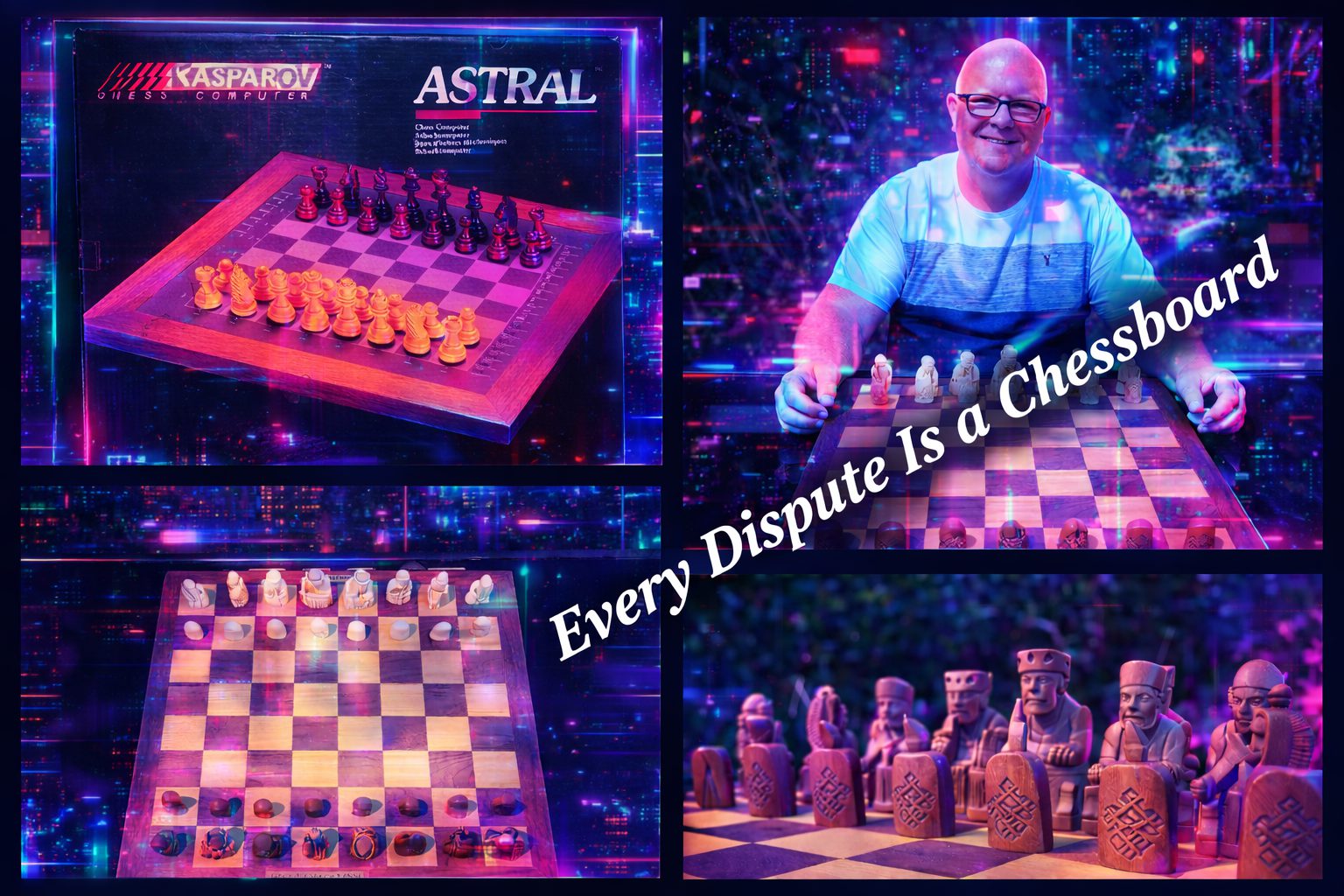
I’m on holiday and on Friday I spotted it in a Holsworthy charity shop window: a Gary Kasparov electronic chess computer. It was wedged between a pile of faded paperbacks and a bread maker that had clearly had a full and meaningful life. The shop was closed until Monday, so, like some saddo, I waited – all weekend.
On Monday morning I made sure I was there for opening time. I must have looked slightly over-invested standing outside before the door sign was changed to “Open”. I said, probably too rushed not to be sad, “I’ll have the chess game in the window please.” The assistant smiled and said,
“It’s been waiting for its special person.”
Apparently that was me. LOL.
This probably tells you more about me than it does about charity shops, but I’ve always had a weakness for chessboards and the longer I’ve worked in mediation and arbitration, the more I’ve noticed how much disputes resemble a chessboard. Not in a dramatic sense, but in a structural one. Every conflict has a framework. The people involved have defined powers and constraints. And every move alters what becomes possible next.
That’s as true in a modest consumer arbitration as it is in a high-value commercial dispute.
The Board Shapes the Strategy
In chess, the opening matters. It shapes the middle game and the middle game determines the endgame. ADR works in much the same way. Mediation creates one kind of board – arbitration creates another. Adjudication accelerates movement and early neutral evaluation shifts emphasis again. Sometimes parties try to negotiate inside arbitration or litigate inside mediation. It rarely works well. The framework quietly influences behaviour whether we acknowledge it or not.
The King – The Parties
In chess, everything revolves around the King. It’s the most important piece and the least mobile. Parties ultimately decide whether to settle or continue, but they are rarely unconstrained. Commercial exposure, legal advice, reputational risk, regulatory duties and internal politics all limit movement.
From the outside, caution can look like stubbornness. From the inside, it usually feels like risk management.
A poorly judged move can expose far more than intended. Good dispute resolution recognises that reality rather than pushing people into gestures they can’t sustain.
The Queen – The Commercial Mediator
The Queen is the most flexible piece on the board. She can influence almost everything. A skilled commercial mediator operates in a similar way. At different moments you might facilitate joint discussion, move between private rooms, test assumptions, reframe risk or simply create enough calm for better judgement to return.
But there is an important difference. In chess, the Queen can force checkmate. In mediation, the neutral cannot force settlement.
Influence is not control. The outcome belongs to the parties and the mediator’s role is to help them see the position more clearly than they did when they arrived.
The Rook – The Arbitrator
Rooks move in straight lines. Clear, direct and (relatively) uncomplicated. That’s arbitration. When parties want certainty rather than exploration, the board narrows. Evidence is considered and submissions are weighed. A binding award follows.
Arbitration does not promise mutual satisfaction. It promises finality. In many sectors, finality is precisely what is required.
The Bishop – The Specialist
Bishops remain on the same colour square throughout the game. Within that domain, they can be highly effective.
Specialist mediators and arbitrators work in much the same way. Deep knowledge of travel, construction, employment or family disputes changes how arguments are tested and how risk is interpreted.
Process skill matters, as does terrain.
The Knight – The Indirect Route
The Knight moves differently. It approaches from angles others cannot. It leaps where others are blocked.
Transformative or restorative mediators often take that route. They focus less on positional bargaining and more on communication, perception and meaning.
That approach does not suit every dispute. But in some cases, it’s the only thing that unlocks movement.
The Pawns – The Infrastructure
Play enough chess and you stop underestimating pawns. They control space, they absorb pressure and they create structure. In ADR, that role belongs to case managers, administrators and junior practitioners. They manage timetables, bundles and communication. Without them, the board descends into chaos long before any mediator or arbitrator has impact.
And occasionally, just like in chess, a pawn reaches the far side and becomes something more.
The Endgame
Early in a career, there can be a quiet admiration for decisive wins but experience tempers that.
Checkmate is clean, absolute and leaves at least one side feeling pretty rotten.
Settlement, when properly reached, is more nuanced. It requires realism, risk awareness and the discipline to accept that total victory is rarely available without disproportionate cost.
The most effective ADR professionals are not asking whether a point can be won. They are asking what the board will look like if the dispute continues unchecked – commercially, legally and reputationally. Continuation always has a price.
The Last Word
I try to finish each Greggonomics with a quote, and this one felt too appropriate to ignore:
But he can’t be blamed, He’s only a pawn in their game. Bob Dylan
Dylan wasn’t writing about chess. He was writing about power, structure and the uncomfortable reality that individuals often operate inside systems larger than themselves.
That idea appears in disputes more often than we admit.
Sometimes the person across the table is constrained by policy, shareholders, insurers, regulators or internal politics. They may look powerful, but they are moving within limits set elsewhere.
Seeing that clearly changes how you approach the board.
In chess, pawns are not insignificant. They shape space, they create pressure – and occasionally they transform.
In disputes, understanding who is genuinely free to move – and who is not – can make the difference between escalation and resolution. Because before you decide your next move, it helps to understand whose game is actually being played.
See you next time, Gregg.
This article was originally published as an edition of the Greggonomics newsletter on LinkedIn. To receive these updates directly to your inbox and join the discussion, you can Subscribe on LinkedIn or join Gregg’s dedicated community over on Substack.