
Greggonomics 15: Three Nuns and a Priest Walk Into a Room…
You don’t usually realise how simple a solution is until you’ve spent a year and a half proving how complicated the problem has become.
Most disputes don’t begin as legal arguments, they begin as friction. In this case, a sensible decision taken for one reason created an unintended consequence somewhere else. Nobody was purposefully malicious or irrational, but two rational positions soon hardened in opposite directions.
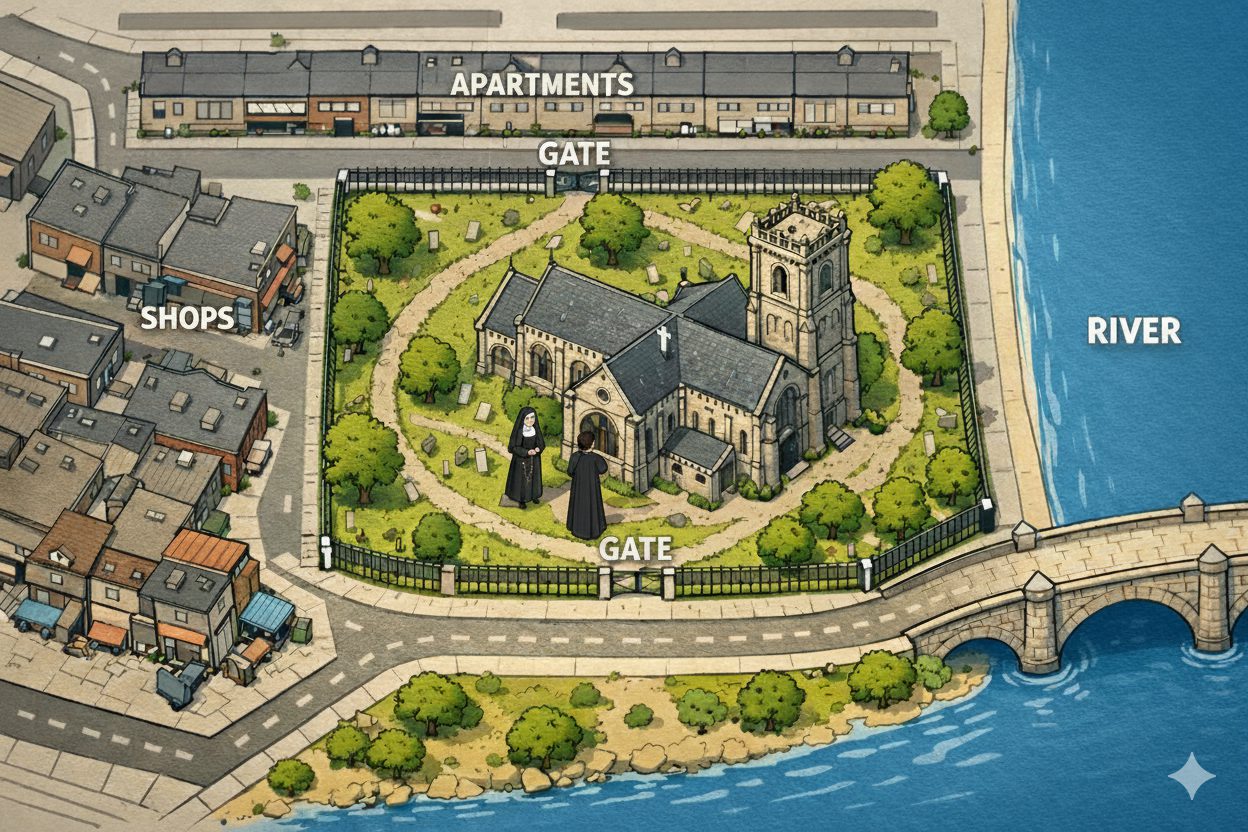
So, there is a tenant, let’s call her Clara, who walks through church grounds to reach her flat each evening. The church sits beside a river and its gates have always been open. Outside the gates is a bridge, and beyond that bridge lies her route home.
The only alternative route skirts a rough estate known locally as “the cut through”. It’s got the lot – gangs, drugs, prostitution, knife crime – it’s not somewhere 26-year-old Clara wants to walk at 8pm.
One spring evening Clara crosses the bridge and finds the church gates locked. She pauses, expecting them somehow to open, but they don’t. It’s nearly 7pm and she’s got no choice but to walk through the cut through. She makes it home, shaken but unharmed. A group of ‘hooded youths’ did linger longer than feels comfortable and she resolves to call the church in the morning to find out why the gates were locked and to make sure they aren’t locked at that time again.
Next day, she has a busy day at work and forgets to call the church and that evening the gates are locked again – this time closer to 8pm. She hears noises from inside the grounds, so she walks quickly and is certain she is followed part of the way home.
The next day she calls and arranges to see the priest. Let’s call him Father Francis. The meeting doesn’t go well. Clara feels dismissed and Father Francis feels misunderstood. The church has discovered evidence of prostitution in the grounds and has decided to lock the gates at 7pm each evening. His responsibility is to parishioners and the integrity of the premises. Both are concerned about safety and both believe they are acting responsibly.
A few weeks later Clara issues proceedings against the church for effectively endangering her by removing access. The local authority becomes involved because of arguments about historic rights of way. Ancient access rights are cited. Pleadings are exchanged and positions solidify.
A hearing date is fixed for eighteen months later.
During those eighteen months Clara continues to use the cut through. She is verbally abused and one night she is physically pushed. She witnesses knife crime. She tries to sell her flat but can’t.
Father Francis lies awake worrying about legal costs, reputational damage and the growing local campaign supporting Clara. A GoFundMe page is set up. and the church’s name is dragged into community debate. Father Francis is also very worried about Clara. She isn’t one of his flock, but he is worried for her and her safety, but is trapped in having to lock the gates.
By the time the hearing approaches, both sides have spent heavily. Neither feels confident and both are entrenched in their positions. At a procedural hearing, the judge suggests mediation. He can’t force it, but makes it clear he would prefer not to see them again.
They agree and two weeks later we are in a small, windowless mediation room. Clara arrives with her solicitor and barrister. The local authority unexpectedly attends with an officer, solicitor and barrister. Then Father Francis enters – followed by three nuns (possibly more), then his solicitor and barrister.
Fourteen people in total. I am there as the mediator’s assistant and for three hours, not very much happens. Arguments are repeated via rehearsed positions and costs are referenced and risks are described and everyone agrees they would prefer settlement but “can’t see a way”.
With thirty minutes remaining, I quietly ask the lead mediator if I may say something. He says yes and I say…
“If only there were a key to settling this, if we could just find the key to unlock this dispute.”
There is a pause. One of the church’s lawyers asks to step outside briefly with Father Francis and five minutes later they return with a proposal. The church will provide Clara with a key to the gate and she must agree to use it discreetly. She must lock the gate behind her and must not publicise the arrangement. Each side to bears its own costs.
Clara agrees immediately. The matter is recorded in writing as a mediation settlement agreement, and the case ends.
As we pack up, one of the lawyers turns to me and expresses how much he thinks mediation is amazing. He says there is no way a judge could have come up with that solution. A judge would (rightly) consider the law and make a decision based on that and not a practical solution to the dispute. He said that they were expecting the trial to be 2-3 weeks and it would have cost in excess of £100,000 in legal fees, easily. He ended by saying:
“Wow, mediation is amazing.”
He was right. Mediation is amazing, and solution based outcomes are so powerful for parties, enabing them to move on with their lives.
A court could have ruled on access, determined liability and produced a lengthy judgment clarifying the law. It could not have ordered (or designed) a solution that preserved dignity on both sides.
The key worked because it solved the real problem without creating a winner and a loser.
The church kept its gates locked. Clara kept her safety. No precedent was created. No public defeat recorded. No reputational disaster unfolded.
The Last Word
I try to finish each Greggonomics with a quote, and this one feels particularly apt – especially as Margaret Heffernan work has long been part of the ADR conversation:
“For good ideas and true innovation, you need human interaction, conflict, argument, debate.” Margaret Heffernan
The dispute itself wasn’t the failure, the failure was outsourcing the conflict entirely to the legal process. For eighteen months, everything had been formalised and human interaction narrowed as more lawyers got involved and more money was spent. Debate was purely adversarial rather than exploratory.
The key was not a legal breakthrough, it was the product of conversation.
So, this might sounds a bit corny, but conflict, handled properly, doesn’t destroy solutions – it creates them.
Mediate when you can, train to be a mediator, talk talk talk and use your imagination to find solutions.
See you next time, Gregg
This article was originally published as an edition of the Greggonomics newsletter on LinkedIn. To receive these updates directly to your inbox and join the discussion, you can Subscribe on LinkedIn or join Gregg’s dedicated community over on Substack.